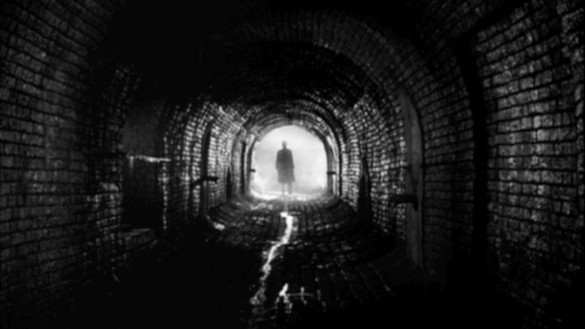
Porfirio in “No Way Out: Existential Motifs in the Film Noir”” says that film noir is “a style and sensibility quite compatible with a literature dealing with private eyes and middle-class crime, one bent on taking a tough approach towards American life.” This approach is interesting being that German expressionism is what so heavily impacted the period of film noir creation, and yet this influence is used for a representation of America. The influence is seen heavily in the details of scenes, and helps formulate an understanding of the, for lack of a better term, genre of film noir. Even Porfirio refrains from treating it like a genre.
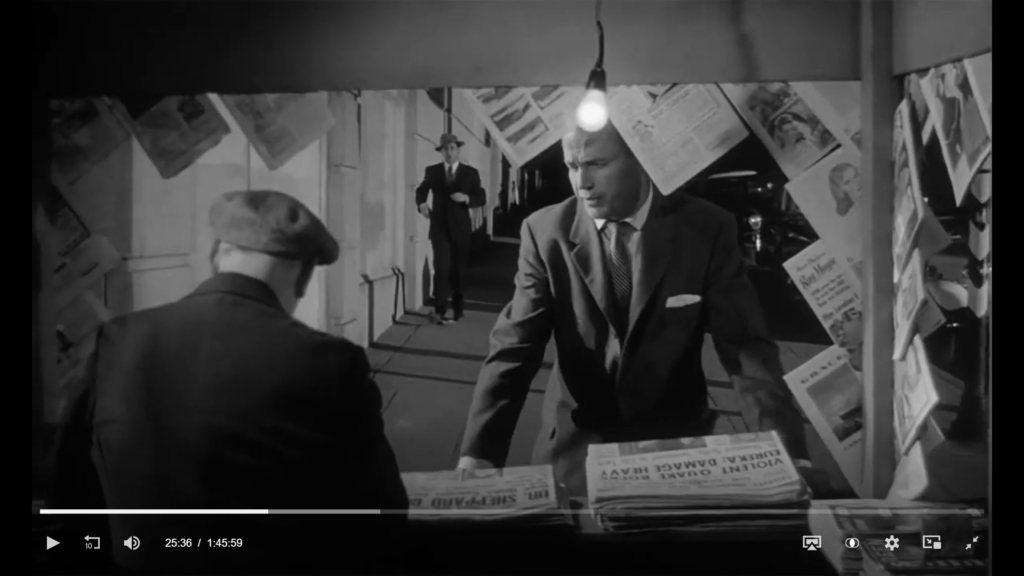
This movement emphasized the darker side of life along with more existentialism, “an outlook which begins with a disoriented individual facing a confused world that he cannot accept,” specifically with emotions being shown through the form of art, like how high strung emotions are shown in film noir (page 81). In Kiss Me Deadly (1955) in the timestamp 25:16, we see an example of this. It is a lovely example of the art of film noir because of its simplicity, merely being a scene where Mike is followed down an empty city street, its smoothness, the shot selection and peaking of paranoid and nervous emotion before a violent and cocky confrontation instilling a confidence in the unexpected ways of this world, and its subtle use of technique but obvious artistic format in the dramatic dropping of a knife and spilled popcorn, when normalcy has fallen away and the potential for mortal injury has entered. Mike, whether conscious of it or not, is disoriented from his ordeal and attempting to face what has happened to him, and this scene and the atmosphere contribute to the theme of the movie. As Porfirio writes, deep focus, “an important element of the noir visual style,” creates an “atmosphere thick with the potential for violence” (page 90), which we experience with this scene.
Main character Mike Hammer, after picking up psychiatric ward escapee Christina, and then crashing and being unconscious while she is tortured to death, and then having his car with her dead body rolled down a hill, is wanting to know who she was and the story behind the event (rightfully so) despite being told to stay out of it. So the scene is him parking his car and then being followed, with his trailer, who is assumed to be making sure Mike does not delve into matters ‘none of his business’ having no idea he is already known about. The most ingenious clip that reveals to the audience that Hammer knows is when he immediately walks to a newspaper stand and a lightbulb is very brightly glaring over his head. A lightbulb over a head is a representation of ‘having an idea,’ and so viewers see through this use of artificial light that Hammer ‘has an idea’ he is being followed. This smooth depiction merges with the idea that “They [main characters] exist in a fluid world whose freedom is rather concretely embodied in sex, money, power and the promise of adventure” (page 88). Mike, in the beginning, is making out with his lover who is urging him to be with her, so his attractiveness is so closely tied with his potential for sex, he is confident in his stride, wealthy in his personality, and cannot help but want to explore what he thinks is ‘big.’
This scene makes it seem like the audience is walking right alongside Mike and the trailer. Throughout the scene, too, is an interchanging of shadows on faces. The biggest change in shadow is when Mike has confronted his tail in a violent way and shoves him down the stairs, the scene ending with a shadow slashing across his face before he walks away into the night. The shadows act as a reflection of good and evil. Another use of light is the use of flames – flames can be referenced as artificial light in this scene despite hints and symbolisms of natural light because of the way it flares a clarity of the face using the lighter. Like film noir cannot be exactly defined, existentialism an another term that alludes from a definition – but we see here, in visuals like this, “a world devoid of any meaning but the one man himself creates” (page 81). Mike has created a notion that he must unearth the story, but it is not for the sake of others but rather himself.
“The noir hero is most often ‘a stranger in a hostile world’” (page 86). What is interesting about this is that Mike is a stranger in his unknowing of the situation, but he is a hostile stranger in a hostile world. This scene so closely ties with the theme and personality of the whole film itself because of the swaggering confidence, the slight hysteria. This scene is motivational for true characteristics being revealed, and is a representation of style and themes of Kiss Me Deadly (1955).