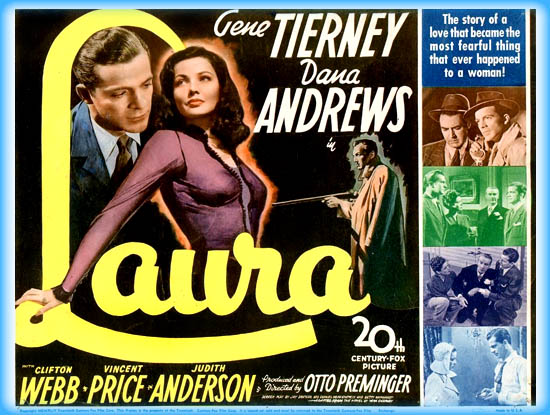
Laura, by Vera Caspary, produced by Twentieth Century-Fox, opens with a close up of a portrait of the title character, Laura Hunt, followed by an unexpected quote from the narration of Waldo Lydecker, a writer and friend of Laura, saying, “I shall never forget the weekend Laura died.” From the start, Lydecker sets the tone for an intriguing murder story. The slow, paced melodramatic tone of Lydecker is placed over a camera pan across Laura’s expensive apartment in a one-take style shot, showcasing a vast array of expensive items in a glass case. The narration of the scene at this time creates an eerie and mysterious atmosphere, hinting at danger and thrill. Lydecky does this by describing Laura’s death like “ a silver sun burned through the sky like a huge magnifying glass” Lydecky emphasizes how unforgettable this day was for him, as he also states “It was the hottest sunday in my recollection. With Laura’s ‘terrible’ death, I was alone.” These elements found in the beginning of the film such as: disenchantment, alienation, and ambiguity found in the narration, the slow camera movements, and the slow paced movement from detective McPherson, embraces the viewer in being taken on a classic Noir Whodunit journey.
In Telotte’s: Voices in the Dark, 1, he mentions in relation to narration in Noir film that, “they deploy the darkest imagery to sketch starkly disconcerting assessments of the human and social condition. In their vision, crime and corruption seem almost a matter of decor, dark trappings of a world suddenly shown in a new and most revealing light”(2). These characteristics and elements described by Telotte were portrayed in the opening scene of Laura, through the direction of Otto Preminger, story by Vera Casapry, and production from Twentieth-Century Fox to create a classic noir masterpiece.