Laura’s opening scene is, in my current understanding of film noir, a textbook example of what film noir narration/narrative style looks like. I believe this to be the case and it starts with our narrator/supposed protagonist. Both within the sound of their voice and the dialect they opt to use, rings common themes present within Film Noir. The complex and wordy semi-melodramatic statements and phrases. The emphasized vocabulary and enunciations of sentences. The slow and melancholic delivery. It all works together to produce what I can only refer to as a person delivery a gospel of dialogue.
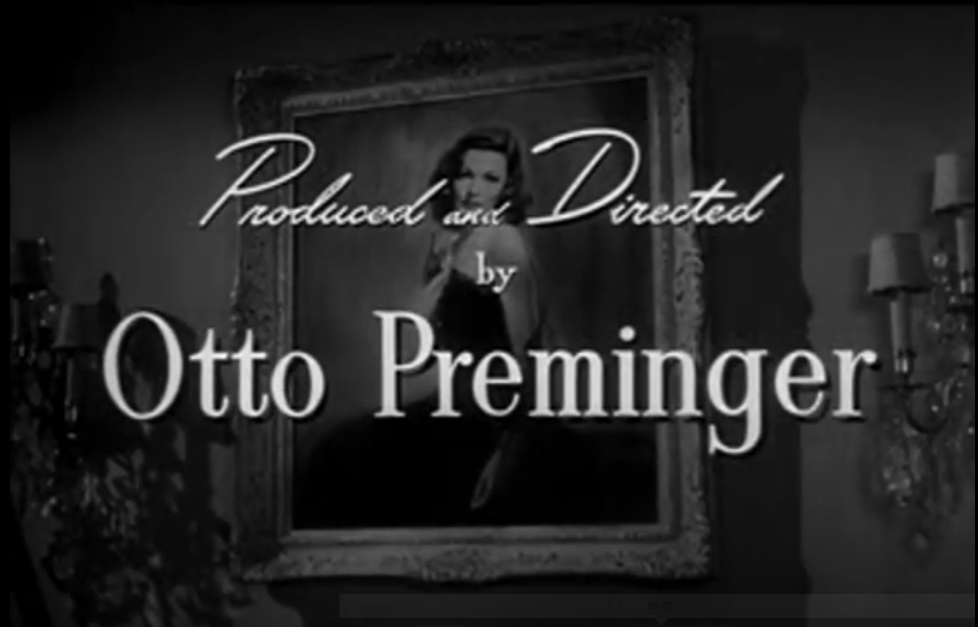
Speaking of dialogue, the films first line of dialogue, just 10 seconds from the opening credits coming from our narrator reads: “I shall never forget the weekend Laura died.” We the audience have not seen Laura at all (unless we assume the painting the movie shows right before the narration begins and the fade to black is her), and obviously therefore have no investment in her character/identity, all we know is that she, whether at the “omniscient-point” of the narration, or eventually will be, dead. This brings an interesting interaction, at least for myself, as I find that I keep going back on forth on whether, at this extremely early point the movie, this detail “matters” to me. To give this more context, let us think about the first scene in Sunset Blvd. (the one we watched in class). The narrator/protagonist presented there is the one that is dead already, face down in the pool of a mansion. But the key thing is we the audience are then interested to see how our already dead protagonist got to this point. We are given visual and audio based identification/confirmation (thanks to the narrator being the omniscient version of his dead self) before we even see the character alive. Meanwhile, now coming back to Laura, we have a different story. Our narrator/supposed protagonist is NOT Laura. We again, don’t get any identification of Laura outside of what the narrator tells us through his sermon-like delivery, and even in that he gives more emphasis on his perspective/thoughts about it. The plot/director deemed it necessary for us to start of the movie in this way, as if to give us just a little under satisfactory amount of information that we the audience want (as is typical of any mystery/murder/detective film).
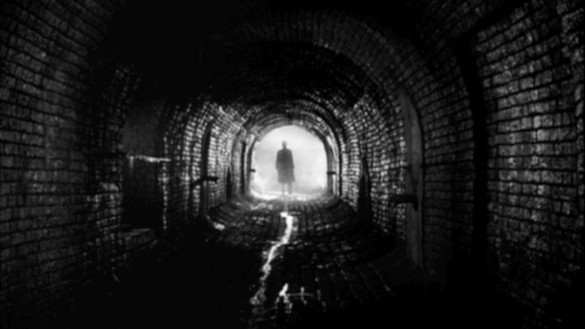
Christopher’s Into The Labyrinth does an excellent job of contextualizing/representing the ideas here, both in concept and energy. The idea of The Labyrinth (something I was aware of, but did not realize the scope of, at least past its mythological roots) fits right into the idea of the film noir, and Christopher demonstrates this in the first 7.5 pages, opting to present us a story, or a cut-out of one, not so unlike Laura or other works we’ve looked at. Once he starts his “proper” exposition, his first two sentences stand out: “From this classic model of the film noir, dozens of variations radiate. The hero is always an American between the ages of twenty-five and fifty. The labyrinth is an American city (Pg. 8).” The idea of the protagonist reflecting the journeys of those of in Greek (and other) myth provides us with a model of which we can further understand them and their actions, both in the sense of the story as well as plot. Anecdotally, I appreciate that Christopher, at least here, gives the underlying perspective/idea that the hero could be non-male, even if it is something we unfortunately don’t see much of in this time period. There’s a argument to be had about the nature of the femme fatale in this, but that’s a different topic for a different time. It’s also worth mentioning that Christopher also gives attention to the idea of the “omniscient death” mentioned prior, and ties in it to what we’ve been discussing, and likely will continue to discuss as we move forward.
“There are other noir films in which it is clear from the first scene that the voice-over narration will be a posthumous one. The hero is clearly dead, and now he’s going to tell us how he died. By way of imaginative voiceovers-alternately presenting facts, uncovering motives, probing his own psyche the hero will guide us back into the labyrinth, retracing the path he followed to his destruction. He does so with varying doses of bravado, self-deprecation, and fear. His voice is usually an amalgam of many elements, at once knowing, sardonic, soothing, obtuse, arch, resigned. That it is invariably a streetwise voice is ironic, for the story he tells is one in which his street wisdom seems to have failed him on account of willfulness, arrogance, or a host of other character flaws which surfaced in the crucible that preceded, and precipitated, his entry to the labyrinth.”
Into the labyrinth – Pg.9
