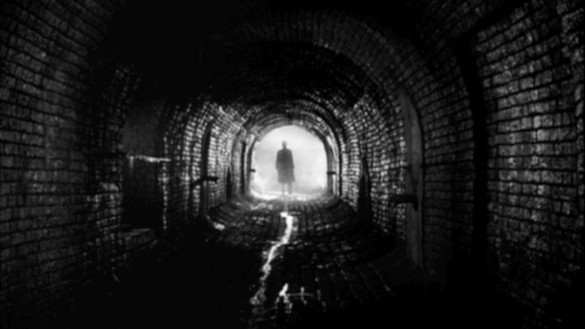
Kiss Me Deadly (1955) is a film noir about mystery, attempted murder, and an inexplicable urge for the truth. Main character Mike Hammer, after picking up a young woman hitchhiking before getting into an automobile accident and her subsequent disappearance, cannot leave the matter alone. Even after the police warn him not to get involved in the investigation, he cannot help it. We see how often it crosses his mind, to the point where his assistant Velma, before getting involved herself, seems to tire of the subject. Yet, even after countless warnings from the police themselves, voice messages, and even a car bomb (although, whether this is considered a ‘warning’ or one of the attempted murders can be debated), Mike continues delving himself further into this plot for a girl he knew for less than ten minutes.
Mike Hammer, personal investigator, is a skilled man. He finds out about Christina Rossetti quickly, and meets her roommate. His skill is also shown through dramatic and tense sequences, including but not limited to fight sequences as well as scenes where he figures out particular plots against him (and, to a degree, also his friends and coworkers). There is no doubt that Mike Hammer fits the archetype of the noir protagonist: determined, good yet rugged, and someone who must bear this burden on his own shoulders.

This film perpetuates some ideas that Christopher gives us about film noir: that it features an “American between the ages of twenty-five and fifty. The labyrinth is an American city. The time is 1940 to the present, which a special concentration on the years 1945-1959” and “the hero will guide us back into the labyrinth, retracing the path he followed to his destruction.” This describes Mike’s core very well, as he leads his friends and coworkers to their demises over his infatuation with the missing case of Christina, who in this case represents the labyrinth. The corruption in this city runs rampant, and we experience just how deep it runs through Mike’s discoveries as he trudges the path to figuring out what happened to Christina.
In the scene where Mike gets the phone call warning him off the case, we see a lot of these elements of film noir. A sense of just how deep the corruption runs, and the hero’s determination to see this through just by the expression shown on his face. Despite the danger, it was never a question to the hero whether or not he should insert himself into this case: he was always a part of it.
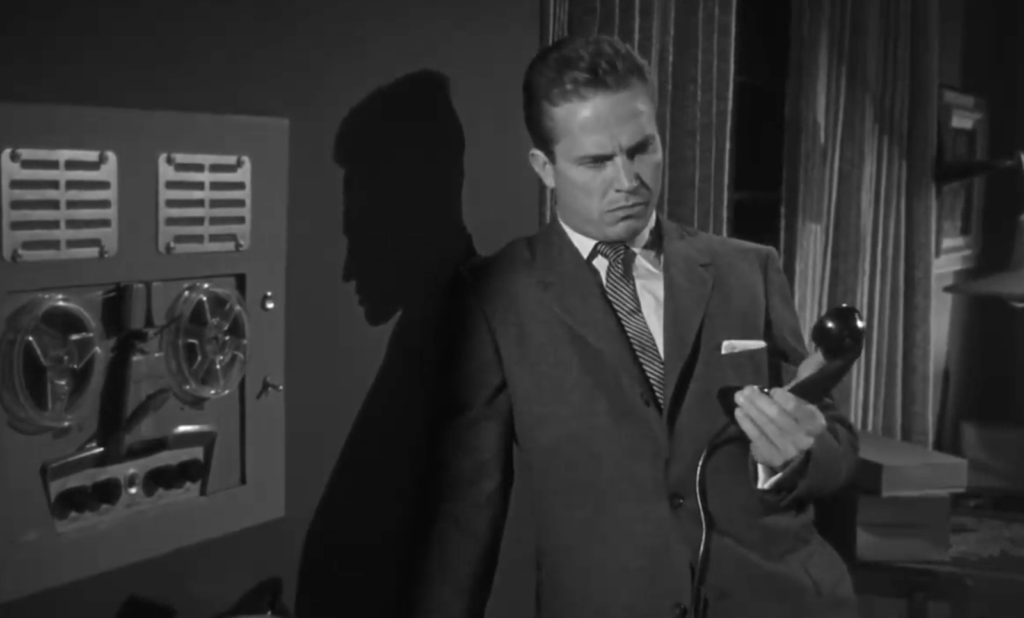
The scene itself isn’t entirely too interesting visually, with close up shots of the voicemail machine running before Mike picks up the call, and a half-body shot of him sparsely conversing with the person warning him off on the other side. The shot provided above is, perhaps, the most interesting of them all, with Mike turned away from the voicemail—a chance to turn away, for safety—with an almost disgust and determination, while his shadow stares it down, a silent promise that he will get to the bottom of this case. A faceless and bodiless voice telling him the path will be dangerous, and even going so far as to threaten him. He considers the phone in his hands, an opportunity to make peace, before hanging up.
The dialogue in this scene, and especially this shot, compliment each other and the theme of the truth. It is, perhaps, my favorite example of characterization of Mike in the entire film. He doesn’t need to see the evil in order to have a sense of justice, and he doesn’t sway from his ideals for even a moment. He stays true to the theme of the film, and to his quest for the truth, even if it’ll kill him along the way. Its simplicity allows us to not get distracted from this, and allows the voicemail’s monologue to carry its true weight and emphasis with it, and lets us know that whatever happens after— the death of his friend the mechanic, the femme fatale and Velma’s fate, is his decision at this turning point in the film (although, to us and to Mike, there was no ‘turning point’ to be done, as the choice was already made up in our minds).
