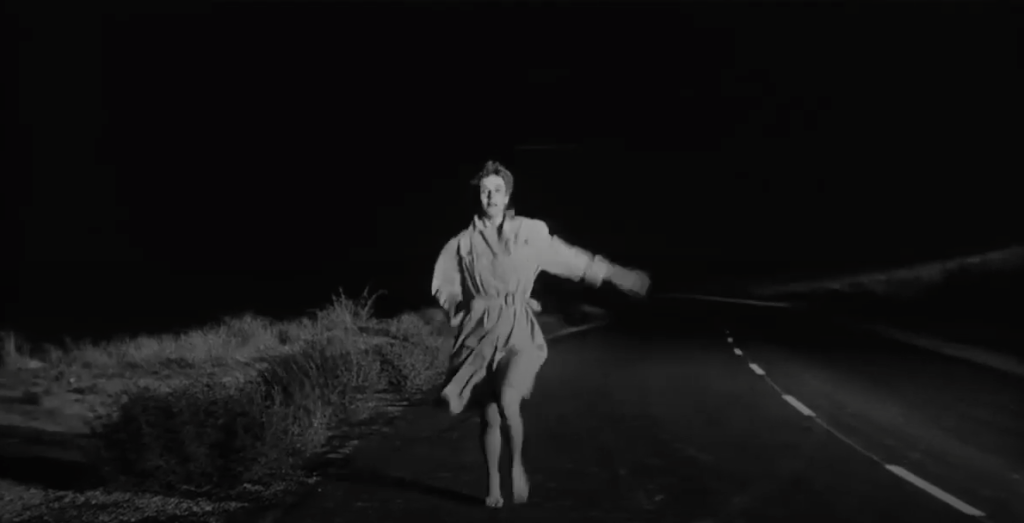
The opening scene of Kiss Me Deadly is a perfect example of film noir existentialism. The woman, Christina, runs barefoot down the road, desperate for help. She is lost, confused, and trying to escape something. She is the embodiment of the existentialist attitude that Porfirio describes, “a disoriented individual facing a confused world that he cannot accept”(81). Her fear and desperation emphasize the “negative side” (81) of existentialism, which emphasizes, “life’s meaninglessness and man’s alienation”(81), as Porfirio states. Christina is alone and alienated from society, and her encounter with Mike Hammer only reinforces this fact.
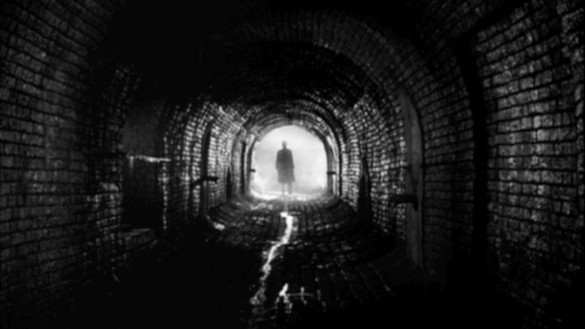
Nicholas Christopher’s book, Somewhere in the Night further, in which he discusses the city as a labyrinth, and how the labyrinth is the human condition in which characters intersect and interact in the city. This emphasizes Christina’s situation. The city is a physical maze of streets, buildings, and tunnels, but it is also a metaphorical maze of plot twists. Christina’s fear and desperation reflect the city’s “psychic atmosphere in which nightmares and dreams, the fantastic and the mundane, collide at every turn.” (Christopher 17).
The city’s role in film noir is also highlighted in Christopher’s description of the various labyrinths in the city landscape. The city is a place where people can hide and disappear, and where the criminals can thrive in the shadows. This sense of danger and uncertainty is visible in Kiss Me Deadly, as Christina’s and Mike’s first 9 minutes together is filled with mostly empty dark streets (00:25)-(07:32) , shops (05:45), and a gloomy city atmosphere. Mike Hammer’s role as a private detective highlights this theme even further, as he navigates the city’s maze and interacts with its inhabitants.
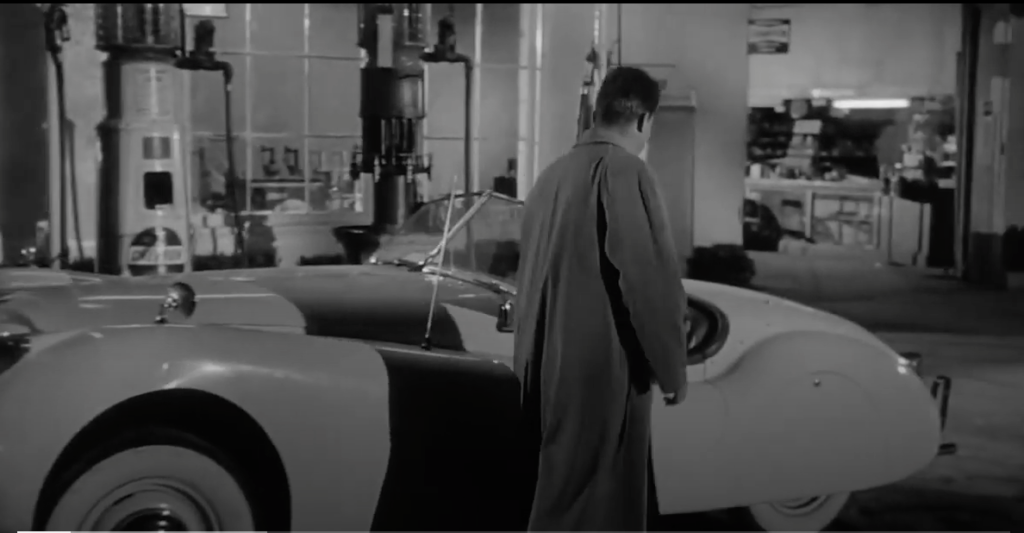
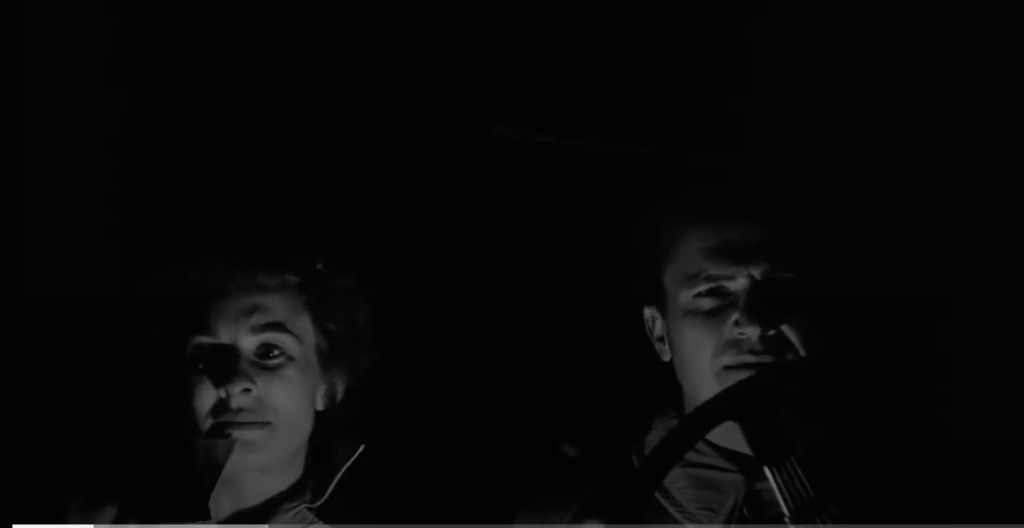
Porfirio’s discussion of the noir hero as a stranger in a hostile world is also evident in this opening scene of Kiss Me Deadly. Mike Hammer is the typical noir hero, a man who is willing to take risks and confront danger in order to uncover the truth. He is a stranger to Christina, but he also embodies the loneliness and alienation that Porfirio describes. His emotional detachment is a necessary part of his job, but it also contributes to his sense of isolation.
Both Porfirio and Christopher emphasize the idea of choice in existentialism. The individual must choose between “being and nothingness,” (Porfirio 87) and must be willing to cast aside the weight of “outmoded beliefs” (Porfirio 87) in order to embrace freedom and authenticity. Christina’s choice to seek out Mike Hammer is a choice between being caught and facing certain death or taking a chance on a stranger who may be able to help her. Mike Hammer’s choice to help her is a choice between taking on a potentially dangerous job or walking away from a woman in need.
The opening scene of this film is an example of the themes of existentialism in film noir that both Porfirio and Christopher discuss in their work. This city is a maze of physical and metaphorical complexities, populated by characters who are lost and alone in a world without values or moral absolutes. The existentialist emphasis on freedom, authenticity, responsibility and the “leap into faith”(Porfirio 81), is evident in the choices made by both Christina and Mike Hammer. The darkness and uncertainty of the film noir are evident in the opening scene, setting the tone for the rest of the movie.
