For this analysis of the 1955 Film The Big Combo, we start at 1:13:25, basically at the very end of the film.
The Big Combo (1955) “Silent Punishment” Scene
The scene I linked doesn’t start when I start talking about it. It starts abruptly after a bit of set-up has already occurred. It’s a quick link to a poorly cut YouTube clip basically.
This link, however, is the full film I viewed and the timestamp should be a proper time for the full analysis.
We start with a car driving up. As the audience, we’re only seeing these headlights pulling up into the garage surrounded by a deep fog. This sets us up for some suspicious activity going on. We cut to another cut of two men getting out of this car, it’s another wide shot where we can’t see who these men are; one of these men are holding a suitcase. We get a tracking shot of these men as they walk away from the car which tightens up as the men walk closer towards the camera. We get a staggered, lower over-the-shoulder-esque/medium shot over McClure’s shoulder. He’s speaking/hinting of a takeover to Mr. Brown. We can see between them, a lighter flicker in the background, building some tension as we know there’s other people in the darkness awaiting them. The men in the background make themselves known holding two tommy guns, the music crescendos. McClure speaks smugly as if he’s successful in his attempts to take over. The camera angle changes to an over-the-shoulder shot where we’re staring at McClure over Mr. Brown’s shoulder. The way the shot is stylized hints to the future of the scene; whereas the camera is pointing slightly downwards towards McClure, in a way hinting at the power that Mr. Brown has still has in this situation. The camera cuts to a close-up of Mr. Brown as McClure is still speaking; he has a blank reaction. We once again cut back to the staggered, lower over-the-shoulder-esque/medium shot as McClure tells the men to gun down Mr. Brown. The men turn their guns towards McClure. This is where the clip I linked starts from.
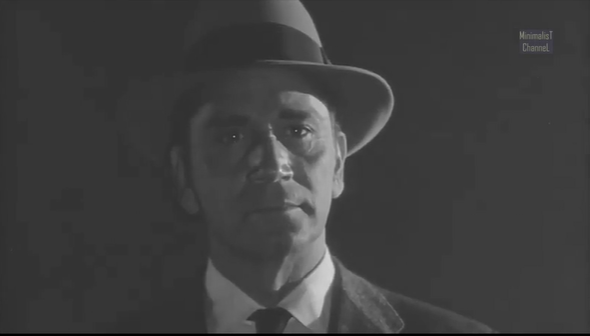
We cut to a tighter over-the-shoulder shot of Mr. Brown as McClure starts to back up in shock and betrayal. As he backs up, the camera tracks him as he attempts to bargain with the other men slowly walking him towards the wall. The camera stops as the men back him up against a wall. The gunmen take up half of the shot as the other half shows how small McClure really is in this moment; he ran up against the wall attempting to find a way out to no avail. McClure pleads as we cut to another close-up shot of Mr. Brown’s same deadpan blank face. We cut to a new shot of the two gunmen taking up the right side of the screen with Mr. Brown in the background to the left. This shot is a mirrored shot of the previous shot. The difference is once again the power difference between the two. Mr. Brown walks forward, towards the camera and McClure, pushing aside the gunmen as he walks up close to McClure. We cut to the previous shot as Mr. Brown walks slowly up to McClure. We cut to a slightly tighter medium shot as Mr. Brown looks down at McClure, in a way mockingly pitying him. We get a close-up shot of McClure’s face as Mr. Brown says “You won’t hear the bullets.” Mr. Brown takes out McClure’s hearing aid and throws it to the ground. Silence. No audio can be heard now. We cut to the two gunmen shooting their gun. Now, we see a shot of Mr. Brown, same blank expression, walking towards the right side of the screen as we fade to black.
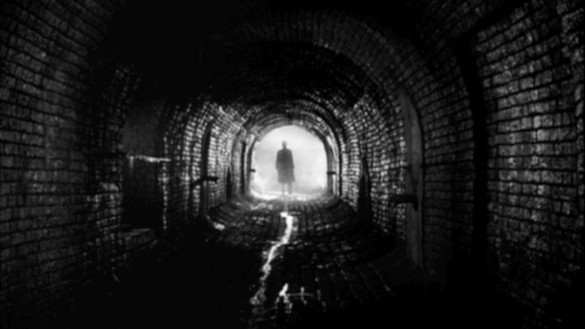
I feel the scene I selected is perfect for highlighting some visual motifs seen in the films noirs. For the following aspects I will be discussing, I will but utilizing the “Some Visual Motifs of Film Noir” reading by Janey Place and Lowell Peterson. First we’ll start with lighting. In this scene, we can see many choices in lighting; like for starters the overall scene lighting is low-key. What I mean by this is that the lighting present in the scene that is mostly noticeable are the lights from the car’s headlights, the lights peering in from the windows from the outside of the building, and the shots being fired from the guns; these choices in placing of such lighting are a staple of the films noirs.
Another staple can be found in the camera angles, the one shot I’d like to highlight is the almost extreme close-up found in the seen with Mr. Brown and McClure. Focusing in on these close tight shots of just their head or face is a key way of portraying an uncomfortable, tough type of shot. With these choices in camera angles/placement and lighting angles/placement, this all adds to the mise-en-scene designed to unsettle the audiences viewing such films noirs.
All these choices in camera work and lighting presented in this one scene is the perfect example to see a sequence utilizing all these aspects of the style of the films noirs. This scene, even this film, I feel is a perfect example and watch for the essential films noirs viewing experience.