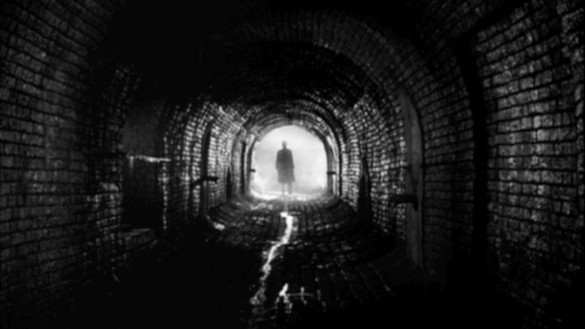
From the beads of sweat the constantly run down Michael’s face all the way to the close ups that we get on all of the characters in this scene, a number of different visual motifs that Peterson speaks on in his piece show up throughout the film and specifically in this scene. Different types of lighting and specific shadow placement among other facets of filming all play a role in adhering this film to the standards of typical film noir visual motifs.
Nearly every time that Elsa Bannister touches our screen she seems to be glowing. No matter the time of day, nor her positioning. Throughout the entire movie and particularly in this scene she is always shown in great lighting, with all of her facial features highlighted, and everything around her seems to be out of focus.
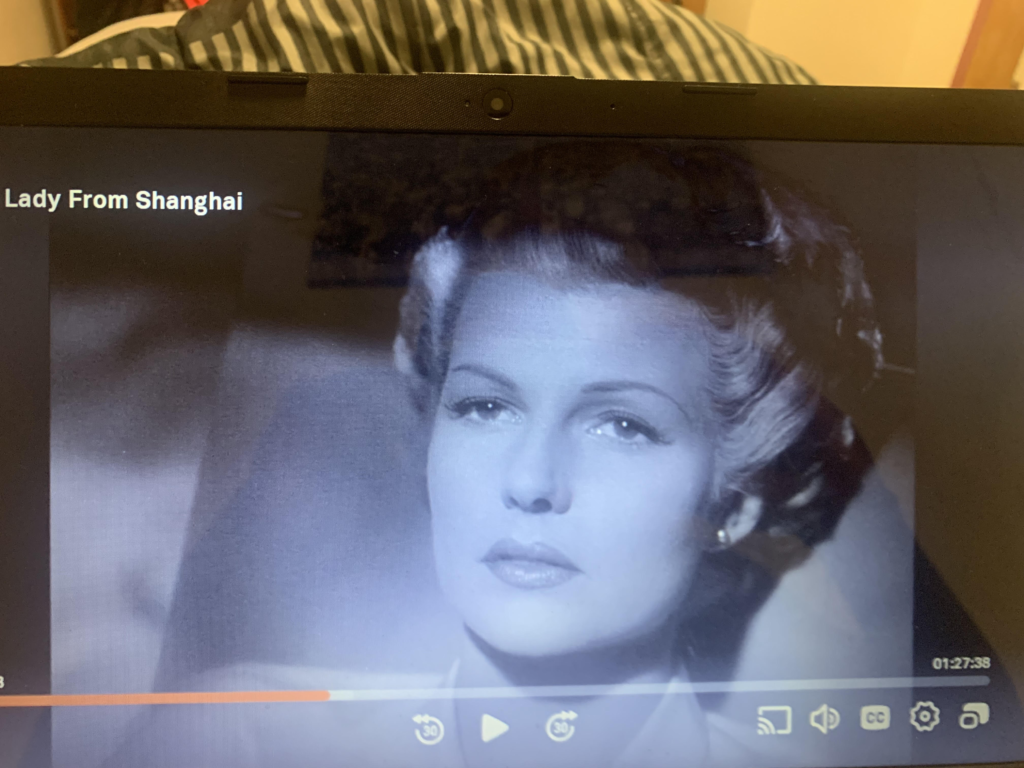
We went over in class how women in noir films often are depicted this way, and Peterson talks of it as well in this quote: “Similarly, those omnipresent framed portraits of women seem to confine the safe, powerless aspects of feminine sexuality with which the noir heroes invariably fall in love.”(Peterson 68) I really love how Peterson describes our film noir women, ” powerless aspects of feminine sexuality”, I just feel like that line in particular really captures how directors used lighting and the softening of their facial features to bolster the sense of sexual attraction, but innocence as well. The super smooth skin, her face appears really soft around the edges, the gleam in her eyes, the gaze, etc… Shots like this extremely sexualize noir females, and we’ve seen this a number of times throughout our class already. This particular shot really reminds of when we first meet Phyllis Dietrichson in Double Indemnity, and she just seems to have this glow about her especially when we first meet her on the staircase, and she is of course in a towel. Elsa has a similar introduction scene which is supposed to be shot at nighttime, but like I mentioned she still manages to glow despite the fact that there are no lights in the shots at all. Her face is just as lit as it appears in this shot here.
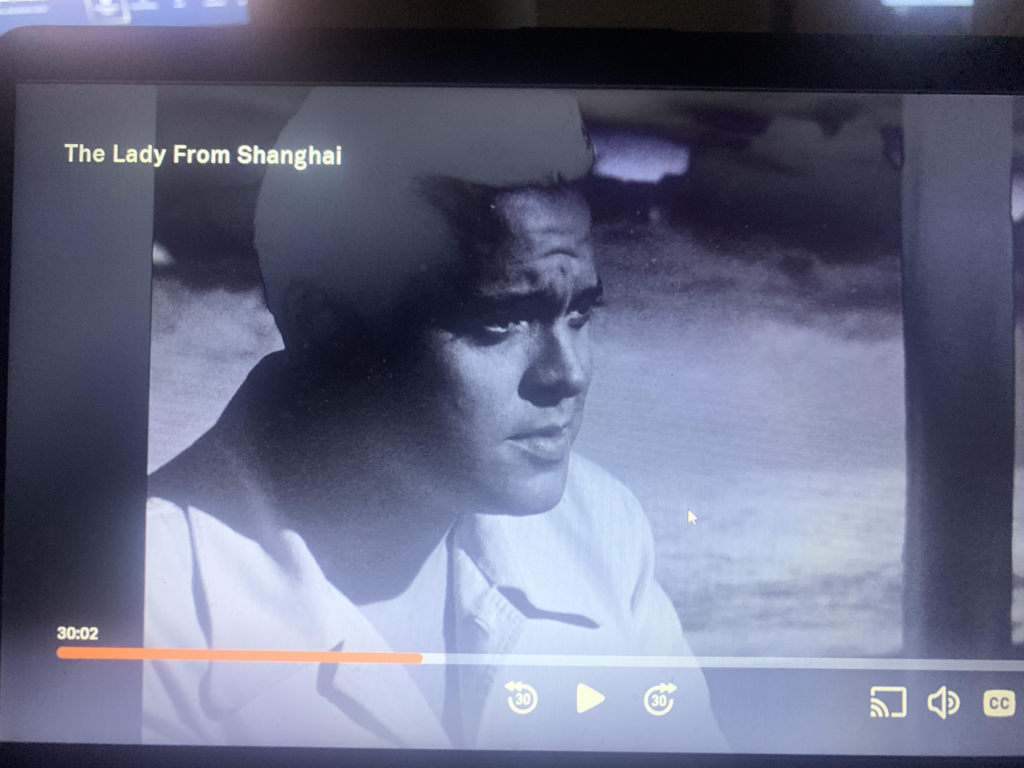
In the same scene our main character, Michael O’Hara has a close up shot as well, and we can see the sky and clouds behind him which to me indicates that there’s still some sort of day light outside, or it may have been a night scene filmed during the day. But nonetheless, Michael appears with almost half of his face being darkened in by a shadow. In the Peterson reading he says quite a bit about shadows and what they could mean and why they are used. ” Shadow areas hint at the hidden, the unknown, the sinister.”(Peterson 70) While it’s fairly clear that Michael isn’t sinister, I do think that in this case the shadowing is representative of the fact that O’Hara knows that his pursuit of Arthur Bannister’s wife is not necessarily ethical. He acknowledges multiple times that he shouldn’t be chasing a married woman, yet he continues to do so throughout the film. Also, much like Peterson states in the quote, in this scene Arthur seems to start becoming aware of the fact that O’Hara is in pursuit of his wife and turns his attention to trying to catch him in the act. So, we get a sense that the shadowing could potentially represent discovering of the hidden/ unknown that Peterson speaks on.
The final thing that stuck out to me in this scene was the lens angle when Arthur Bannister speaks. The audience is set in a fairly awkward position as we are kind of angled to look down on Bannister. Peterson talks about how “wide angles lenses have distorting characteristics…. As faces or objects come closer to the wide lens, they tend to bulge outward,” and here we definitely get a distorted angle that enlarges the forehead and makes for a scene that is a bit more dramatized.
In conclusion, this scene really emphasizes key lighting and camera angles to convey not only the distinct characteristics that women carry within these noir films, but it also uses these visual motifs to foreshadow and get the audiences’ mind moving into the direction of anticipating what may happen next based on these various camera features.
