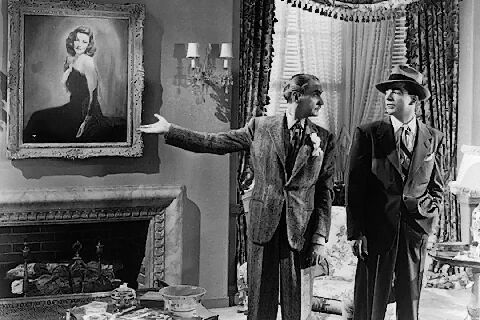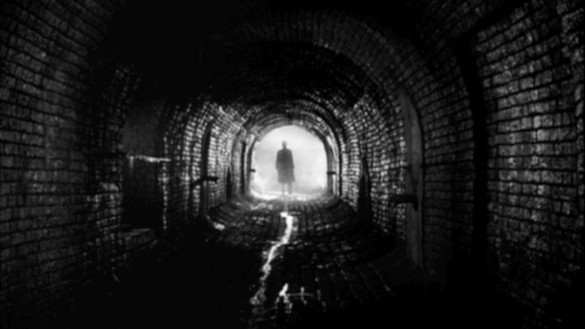
“I shall never forget the weekend Laura died,” the narrator begins in the movie Laura, the screen pitch black before fading into a shot of a dark and blurry candlestick front left to a lit statue in an alcove. Certainly an entrance like no other. Death is often associated with the color black, with nothingness, so a black screen is a perfect depiction for such a morbid beginning. “A silver sun burned through the sky like a huge magnifying glass,” he continues. Prose mixed with an almost Egyptian musical underlining offers a hook we are intrigued to hear more of. Waldo Lydecker is introduced (by himself) as apparently knowing the presumably dead Laura more than anyone. He tells us he will begin telling her story, but “another one of those detectives” came to see him – with the tone he uses for ‘detective,’ included with ‘one of those,’ it is easy to get the sense that detectives are becoming increasingly less welcome in his seemingly lavish establishment.
A sense of who the audience is for this story is also becoming apparent – film noir narrators usually speak to themselves in a sort of way, trying to piece together the unsolvable, but this is being told like a story, like a trophy will be given for the events. Telotte in “Noir Narration” writes that “…by speaking forthrightly, it helps us to recognize, understand, and perhaps better cope with the problems it so starkly describes” (page 2). Lydecker is sharing information that is his viewpoint in the death of Laura, so his method is helping the audience begin to formulate an idea and picture of how the story will go on.
We also see in Laura a few of the dominant narrative strategies that Telotte tells us about in “Noir Narration.” The first is the classical, third-person narrative, because Lydecker seems to have a “perverse pleasure in the events of crisis,” largely Laura’s death. When his voice-over is over, we see Lydecker in a tub on a typewriter, which leads us to believe what he is writing is his inner dialogue that we just heard. It feels too enjoyable for him. The second is the voice-over, because it “offers partially glimpsed truth,” which “raises questions about larger narrative,” and finally, “promises viewers more sense of ‘shared consciousness.’” As a self perceived prominent figure in Laura’s life, Lydecker is taking his sweet time in telling us the story and details and personality, feeling no need to rush and let others know simply because he already does, so, he is giving a rose-colored sunglasses POV, his version of the truth. Through his voice-over, we want to know more about Laura and her death and about Lydecker’s relationship with her. It’s like he is enfolding us in the secret of his relationship with her, or trying to say “ha-ha, I know her and am close with her, and you are not.”
The narration does a fantastic job of guiding us, too, during the time of this intro. We see no camera cuts until 2:37min, but the camera rather follows the detective with which Lydecker is speaking about – it is specifically a great shot when Lydecker mentions how he can watch the detective through a half open door, and the camera follows the detective wherever he goes. Watchers feel they are watching him, too, further attesting to the narrator’s credibility.
Another narration technique is the subjunctive camera. “For even as a subjective camera calls attention to our point of view, it also attaches a human burden to that vantage, the persona whose view we share and whose various characteristics and concerns that vantage illustrates” (page 90). Although audiences may not like it, we are sharing a perspective with Lydecker, whose eyes and vision we are being carried with. Lydecker is telling a story, almost reading from a script, and we want to know the end but must first be pulled through the beginning and middle.
The narration, also, interestingly enough, brings us back to the shot of a clock twice, with Lydecker recognizing it within his narration – he provokes further interest in the mystery of this story by revealing that this clock is only one of two, with the second being in Laura’s apartment. The same room that she died in, specifically. Why is this important? We are entranced to know more. His narration is full of subtle emotion, strings with no ends that we must tie together. His lines and voice compliment the plot – the woman this is about, and her life and death, we are beginning to assume. And this brings the point of again, the woman in film noir, and all that she represents. This woman is dead, we see, and has a hold on the narrator so strongly already, an almost possessive attitude. We know nothing about Laura, but we can tell from Lydecker’s narration that this is another example of the epitome of a woman in film noir. Although Lydecker mentions he knew her best, he does not say that she knew him best, or holds remorse or sadness for what has passed, but there is an edge of excitement, thrill, a hollow whine. The narration and spell is broken with “Careful there,” when the detective goes to touch something and creates a tangible existence, and so the spell has been broken from narrator to character.