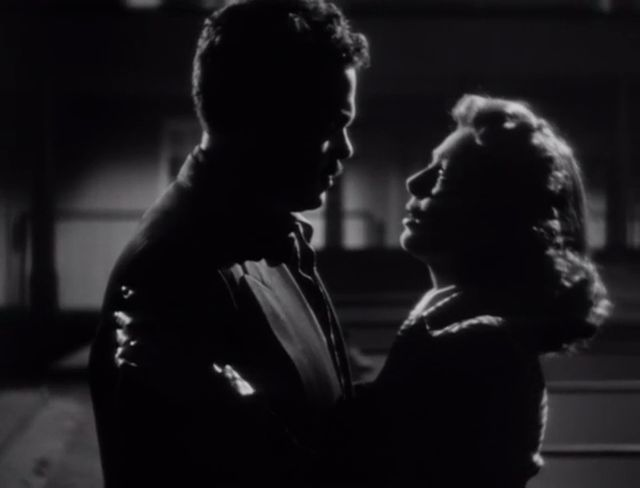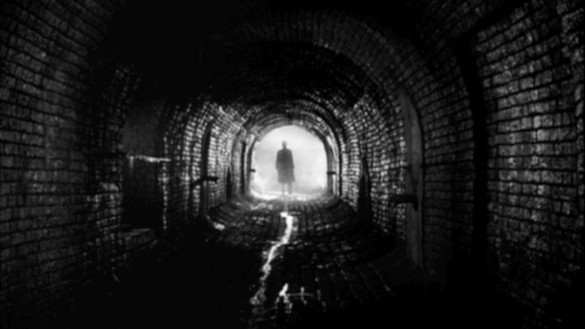
The Stranger (1946) is a thriller that follows Mr. Wilson, an agent, and Nazi fugitive Franz Kindler, as Mr. Wilson is chasing after the latter, and how desperate the fugitive is to keep his secret and continue with his new identity. As the timestamp 32:30 fades into the next scene, we see Charles Rankin, who is actually Kindler, and Mary, his new wife, walk through a door with complete darkness covering Charles’ face. Hinting at the darkness within. As cringe and as cliche as that may sound, it is an entirely true statement with a powerful showcase that blatantly addresses the evil from this Nazi fugitive. The scene cuts to Mr. Wilson, who says Charles is “entirely above suspension,” before the scene cuts again to Charles walking in the shadows of the night with such a stride we know something is amiss. He staggers to the spot where he had buried his former colleague on his wedding night, no less, that would have potentially exposed him. The camera blurs his face, slightly, as he looks around, before focusing and clearing again. The blur is perhaps the haze of his mind and is a crystal shot of the smearing of the entire situation. Then, Red, his dog, has discovered the body, and Charles chases him in a small circle, like a representation of the spiraling occurring, before he appears to kick the dog, and bam, the scene is cut again, back to Mr. Wilson who awakens in the dead of the night to make a telephone call. Back again to Charles, now smoking, laying on the ground next to one of his many victims. Throughout this entire scene are formal shots and elements that attribute to film noir.
Place & Peterson in “Some Visual Motifs of Film Noir” say that visual style is a “consistent thread” that “unites the very diverse films” for the attempts to define film noir, with characteristic film noir moods being claustrophobia, paranoia, and despair. We see these moods portrayed in this scene because of the shot selection. Based on screen size, directors would use “unsettling variations” of shots, like medium and close up and long shots, which we see flowing through this. The camera stays steady as the couple walks into the house and as Charles face comes closer and closer, and then again, in the later part of the scene, it keeps flipping between Red digging up the body and Charles twitching and realizing face, as well as Mr. Wilson’s close up shots as realizations began to dawn. “Claustrophobic framing devices such as…shadows separate the character from other characters…” and we see shadows being framed, like when Charles is walking with Red at 33:10 with only a sliver of light to frame his suit. So, the mood of claustrophobia is portrayed because viewers feel how Charles is being compressed by his own identity.
Place and Peterson write that “Camera movements are used sparingly in most noir films,” which is something we see in The Stranger, although we certainly see more cuts than expected, perhaps because this was a cheaper way of production that film noir utilized. Charles, while not a hero, is “shot in tough, unromantic close-ups of direct, undiffused light, which creates a hard, statuesque surface beauty that seems more seductive but less attainable, at once alluring and impenetrable” (page 66). The fact that his character is a Nazi fugitive contributes to the unsettling and paranoiac vibe, especially since this film was made post World War II when tensions were high, and that real footage from the Holocaust was shown. Yet, back to the scene, we see the way Red is shown from the viewpoint of Charles as digging, digging, digging the body up and how this digging is both physically being done and as a representation of how Charles’ action and past is going to be dug up, too. Another simple way we see visual style being representative of themes in the movie is when after the couple has walked in, Mary begins making her way up the stairs and Charles calls Red for a walk. A pillar in the foyer separates the two, showcasing how separate the couple actually is, how split apart they are, whether Mary realizes it or not. Following this, Charles walks out and when we see Mr. Wilson, it is with a curtain half covering his face, the fill light giving him a soft appeal. This softness and the use of his face being covered alludes to how he is halfway in the dark and obscured from discovering the truth. So many small shots and formal elements add to how this film harbors the components of the film noir visual style.