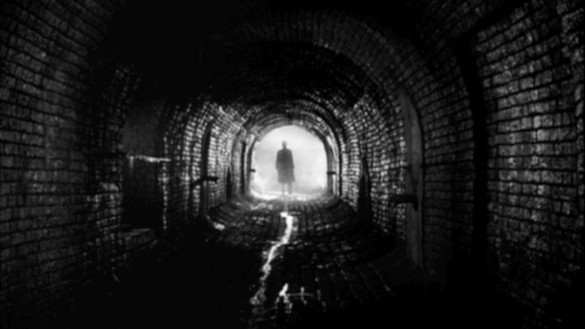
For this post, I will be talking about The Big Combo. The scene in question starts at 13:45 and continues onward. The recognizable features of noir can be easily identified, but to truly understand the weight and scope of these choices we have to take a deeper look at them to understand the message that these visual motifs are trying to convey.
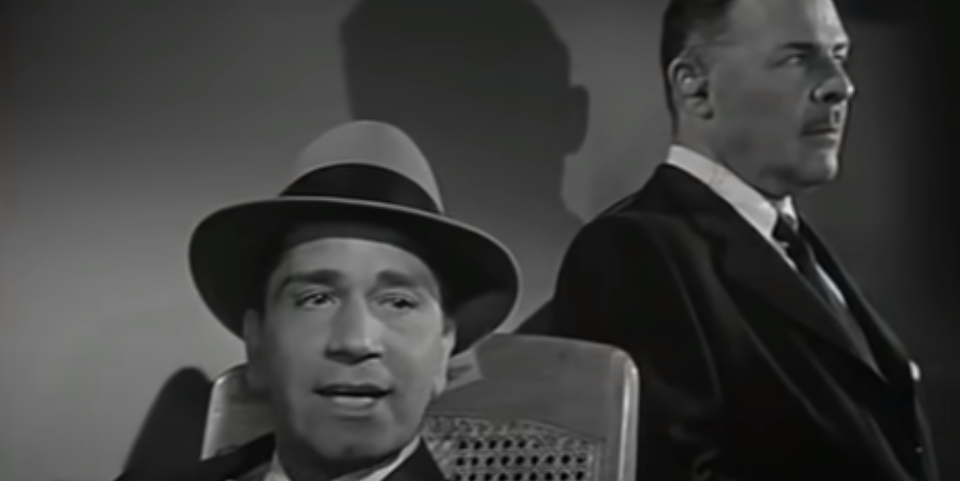
our scene at 13;45 starts with our antagonist Mr. Brown inquiring about his romantic interest. In the plot line of the film, Mr. Brown is seen as a somewhat powerful and dark character holding large sums of power in the city’s sprawling underworld landscape. Upon closer inspection, we can learn this not only from the plot line of the story but from the visual representation on screen. Mr. Brown is seen casting a dark shadow behind him all the way to the left of the frame, and in contrast, our protagonist is all the way to the right of the frame and casting the lightest shadow. The lighting choices were used to show Mr. Brown’s darker nature in comparison to our main character Detective Diamond. This effect is created using lowkey lighting which Place described as “the ratio of fill light is great, creating areas of high contrast and rich dark shadows ” (PlacePeterson 66). The technique of lowkey lighting is used to enhance and bring to life elements of the story and the characters. More importantly, Lowkey lighting isn’t the only visual device used.
The filmmakers also made use of “claustrophobic framing” as Place would say (68). Firstly when we look at the framing of the first part of the scene we see Mr. Brown at the forefront of the shot, he takes up most of the screen. This was a visual nod to the amount of power he holds, and as a result, on-screen he takes up more room thus seeming bigger than our protagonist the police detective Mr.Diamond, who stands in the background of the shot. This creates an almost claustrophobic effect for our detective on screen and allows us to further gain information about the scene with no acting needed, just visual representation or motifs as Place would say.
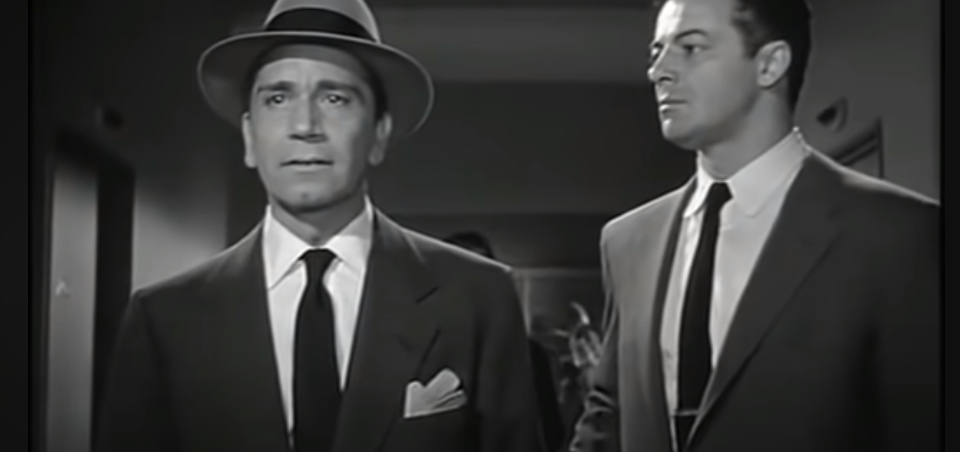
Further into the scene the love interest Mrs. Lowell is rolled in on a stretcher. The two men begin to argue over her future and where she is sent. For both men, this is an intimate conversation about their feelings in many ways. The actor playing Mr. Brown does an amazing job at portraying this with his facial expressions, but when we take a closer look at the framing of the scene we can learn more. Again the filmmakers make use of claustrophobic framing. Overarching the two characters is a small doorway and surrounding them is nothing but walls.
In the same scene mentioned above, we can also look at the screen size used. The camera isn’t far enough away for us to see the surrounding walls and ceiling, but isn’t close enough for us to not care or as Place would describe it ” the noir directors use unsettling variations on the traditional close-up, medium, and long shots” (PlacePeterson 68). The effect of this leaves the viewer feeling uncertain and lacking the means to position themselves. It can also be stated as ” providing the viewer with no means of spatial awareness” (PlacePeterson 68). These feelings are vital in aiding to the plot. At this point neither our hard-boiled detective Mr. Diomand nor Mr. Brown knows the fate of their love interest Mrs. Lowell, and the lack of spatial awareness given to the viewer aids to convey this feeling of uncertainty that both of our characters our feeling in this moment.
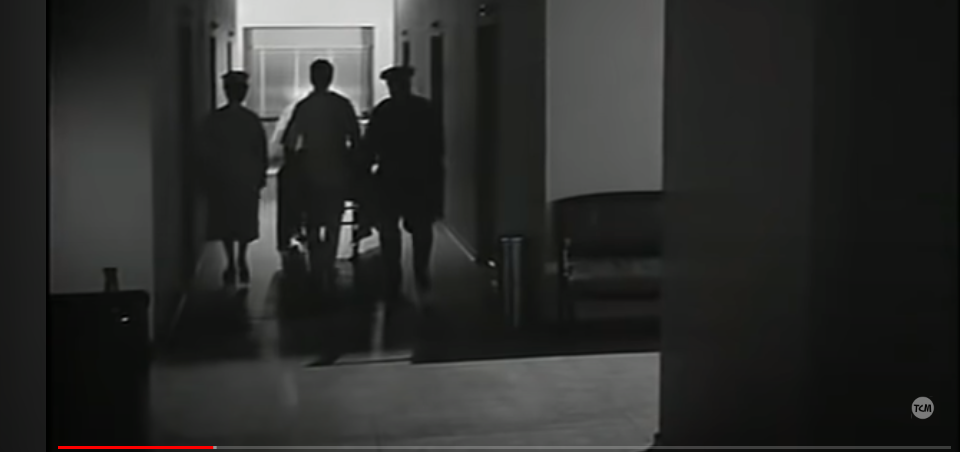
As both Mr. Brown and our detective conclude their conversation the camera cuts to Mrs. Lowell being rolled down the hallway by a group of nurses. Again here we will look at the use of lighting. In this scene, ” small areas of light seem on the verge of being completely overwhelmed by the darkness that now threatens them from all sides” (PlacePeterson 67). This is done by having the main light source at the very end of the hallway, and much of the surrounding area surrounded by shadow. While the previous shot looked to invoke uncertainties in the viewer this one looks to inspire negative feelings, both of our main characters hurt by the trauma of their damsel. In many ways, the visual motifs look to convey the common theme of existentialism in noir or ” a world being devoid of any meaning but the one man himself creates” (Porfiro 81). With the meaning that both men created for themselves being Mrs. Lowell.
Furthermore we can look at the depth of field in the same scene mentioned above. We see the walls surrounding Mrs. Lowell with the same focus we see her in. In many ways, this works to parallel the feeling of the scene. ” The world of the film is thus made a closed universe, with each character seen as just another facet of an unheading environment ” (PlacePeterson 67), and in Mrs. Lowell’s case, she has made her environment consist of men both like Mr. Brown and detective diamond. These two characters represent good and bad in a morally grey world, two forces that will ever be present in her and everyone else’s environment, and the use of a greater depth of field aids us in seeing how permanent and shaping the environment feels for Mrs. Lowell.
Overall the use of claustrophobic framing, low-key lighting, and a greater depth of field helps us not only be told the emotions and themes of the film, but see them visually personified on the screen through the intentional use of the conventions mentioned above.
