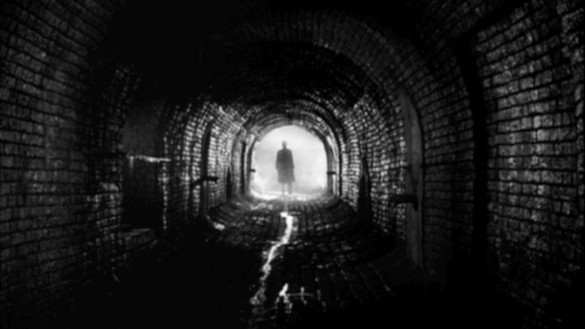
The sources here are shared between the Video Essay and the project. Generally speaking, less of them will be “used” in the Video Essay, and some sources are likely to be more prevalent/relevant in general for both then others.
I MAY have gone out of alphabetical order
1. Borde, Raymond and Etienne Chaumeton. “Towards a Definition of Film Noir.” Film Noir Reader, edited by Alain Silver and James Ursini, Limelight Editions, 1996
–The piece that all of us are likely going to reference one way or another. In my case, it is crucial to get an idea of a “definition of Film Noir” when discussing the idea of the Noir Soul, so this is an essential baseline.
2. Christopher, Nicholas. “Chapter One: Into the Labyrinth.” Somewhere in the Night: Film Noir and the American City, Free Press, 1997,
– Another essential piece for me. Christopher gets at the more “thematic” aspects of Noir, which is practically half of the equation when talking about the Noir Soul.
3. Place, Janey, and Lowell Peterson. “Some Visual Motifs of Film Noir.” Film Noir Reader, edited by Alain Silver and James Ursini, Limelight Editions, 1996,
– If Christopher is the thematic side, then Place & Peterson is more on the direct/literal. Given that I intend to address the historical/socio-cultural factors, and under the guise that media is a representative lens of a society at a given time, understanding the nature of why Film Noir looks the way it does is definitely going to be relevant.
4. Naremore, James, and David Butler. “The Noir Mediascape.” More Than Night, University of California Press, 1998, pp. 255–277.
– Reccomendation as per Dr. Boessen. (update needed)
5. Naremore, James. “American Film Noir: The History of an Idea.” Film Quarterly, vol. 49, no. 2, 1995, pp. 12–28.
–
6. Tarantino, Quentin. Pulp Fiction. Miramax, 1994.
– Pulp Fiction serves a great neo-noir based in the “real-world”. Its a great example of the Noir Soul in effective practice, in the context of the neo-noir world.
7. Scott, Ridley. Blade Runner. Warner Bros., 1982.
8. Villeneuve, Denis, et al. Blade Runner 2049. Warner Bros., 2017.
– Both of the Blade Runners are must-haves when talking about the modern-to-contemporary state of neo-noir. They also serve the purpose of demonstrating the Noir Soul in different contexts, in this case Science Fiction.
9. Eastwood, Clint, et al. Unforgiven. Warner Bros., 1992.
– Similar to the Blade Runner duo, Unforgiven is another perspective of the “neo-Noir Soul,” this time contextualized in the Western. I especially think the plotline is something worth getting into more.
10. Reeves, Matt. The Batman. Warner Bros., 2022.
– Recommendation as per my classmates. (update needed)
11. Scorsese, Martin. Taxi Driver. Columbia Pictures, 1976.
– Another recommendation from my classmates. In this case, not something I’ve already seen. (update needed)
12. Nanten, Yutaka., et al. Cowboy Bebop. Tokyopop, 2003.
– A personal wild card choice of mine. (For context, while I have the original manga/creator of the series cited here, this includes the anime as well.) Cowboy Bebop may seem an odd choice at first, but I think theres merit both in its sci-fi western aspects (as seen with the Blade Runners and Unforgiven), but also as a possible Japanese “take” on the Noir Soul idea.
13. thinking of more as we go 🙂
–
14.
–
15.
–
16.
–
17.
–
18.
–
19.
–
20.
–

We talked about this briefly before, but I didn’t realize all the written sources you’re citing so far are from the course….Definitely need to do some more digging on this: I guarantee there’s much more out there than is cited here.
(One option I’d definitely recommend is to set up a meeting with an Abell librarian and see if they can help you target the topics you want to work with .)